

Lithium Battery Maintenance in Winter Garden, FL
The lithium-ion battery pack is the single most expensive and most critical component on any electric scooter, e-bike, or micromobility device. It is also the component most affected by how the device is used, charged, stored, and maintained. A well-maintained battery pack can deliver years of reliable service; a neglected one can lose capacity rapidly, develop unsafe cell deviations, or fail entirely.
Professional Lithium Battery Maintenance in Winter Garden, FL
The lithium-ion battery pack is the single most expensive and most critical component on any electric scooter, e-bike, or micromobility device. It is also the component most affected by how the device is used, charged, stored, and maintained. A well-maintained battery pack can deliver years of reliable service; a neglected one can lose capacity rapidly, develop unsafe cell deviations, or fail entirely.
Scooter Repair in Winter Garden, FL provides specialized lithium battery maintenance for electric scooters, e-bikes, mobility scooters, electric mopeds, and other micromobility devices. Our battery maintenance service is designed to identify developing issues before they become failures, maximize battery life, and ensure safe operation.
We do not provide DIY battery opening, soldering, or cell-level modification instructions. Lithium-ion cells store significant energy and improper handling can result in fire, chemical burns, or toxic gas release. All battery service is performed by our technicians in our Winter Garden shop using appropriate equipment and safety procedures.
Battery Health Evaluation
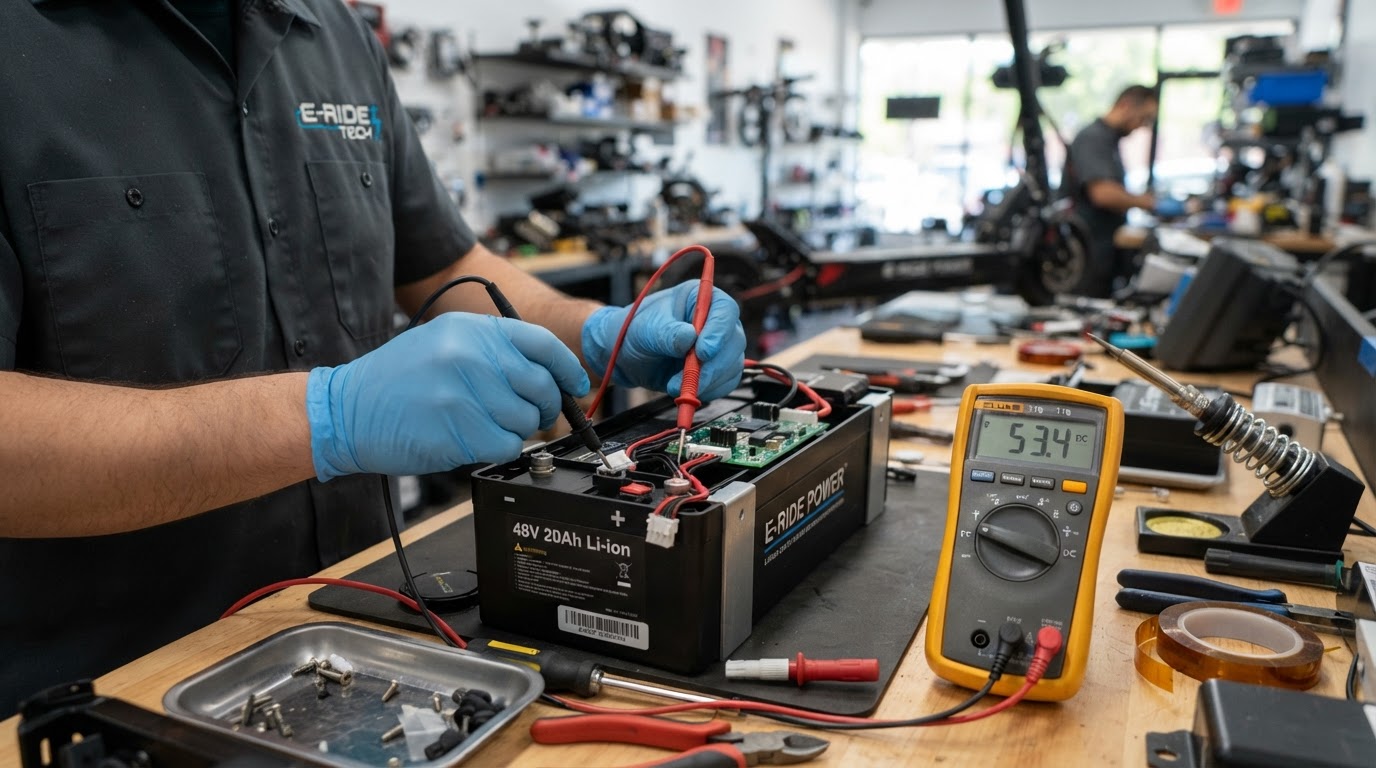
Our battery health evaluation begins with measuring the pack's resting voltage and comparing it to the expected nominal voltage for your device (typically 36V, 48V, 52V, 60V, or 72V). We then check the BMS (Battery Management System) for cell group balance status — verifying that all cell groups are within an acceptable voltage range of each other. An imbalanced pack, where some cell groups are at full charge while others lag behind, loses total capacity and can develop unsafe voltage deviations over time.
We test the battery under load to check for excessive voltage sag — a sign of degraded cells, high internal resistance, or an imbalanced pack. A healthy battery should maintain voltage within a predictable range under the loads of normal riding. Excessive sag indicates that the battery is approaching the end of its service life or has a specific cell group issue.
We also evaluate charge acceptance — how efficiently the battery takes a charge. A battery that charges unusually slowly, does not reach full charge, or charges to full but drops rapidly when in use may have a BMS issue, a degraded cell group, or a charging system problem.
BMS Diagnostics and Thermal Protection
The BMS is the electronic brain of the battery pack. It manages charging, discharging, cell balancing, temperature monitoring, and safety cutoffs. During maintenance, we evaluate the BMS for proper operation of its charge and discharge MOSFETs, check the balance lead integrity, and verify that thermal sensors are functioning correctly.
The BMS thermal protection is tested to ensure it cuts charge or discharge current when the battery reaches unsafe temperatures. In Central Florida's climate, where battery packs are frequently exposed to high temperatures, thermal protection is especially critical. A BMS with a malfunctioning thermal sensor can allow the battery to overheat, leading to accelerated degradation or safety risks.
We check the BMS balance function — the process of bringing all cell groups to the same voltage level during charging. If the balance function is not working correctly, some cell groups will be overcharged while others are undercharged, leading to capacity loss and potential safety issues.
Charger and Charging Port Verification
The charger is tested for proper output voltage and amperage, and we verify that the charger's cutoff behavior matches your battery's specifications. An overcharging charger can damage the battery and create safety risks. An undercharging charger will not fully charge the battery, reducing range. We check the charger LED indicators for accurate status reporting.
The charging port on the device is inspected for bent pins, corroded contacts, loose solder joints, and secure mounting. A damaged charging port can cause intermittent charging, slow charging, or complete failure to charge. We clean the charging port contacts and apply dielectric grease to prevent corrosion in Central Florida's humid environment.
We also inspect the charging cable for damage, check the connector for secure fit, and verify that the charging port cover (if equipped) seals properly to prevent water intrusion.
Lithium Battery Storage Guidance for Central Florida
Proper storage significantly extends lithium battery life, and Central Florida's climate makes storage guidance especially important. Heat is the primary enemy of lithium-ion battery longevity. Storing a battery in a hot garage, car trunk, or in direct sunlight accelerates capacity loss and can cause safety issues. We recommend storing batteries in a cool, dry, indoor location whenever possible.
For long-term storage (more than a few weeks), we recommend storing the battery at approximately 40–60% charge rather than fully charged or fully depleted. This reduces stress on the cells and slows degradation. We recommend checking the battery voltage periodically during storage and recharging to 40–60% if the voltage has dropped significantly.
We also advise on charging habits that maximize battery life: avoiding fully depleting the battery before recharging, avoiding leaving the battery on the charger for extended periods after it reaches full charge (unless the charger has a proper float mode), and avoiding charging immediately after riding when the battery is still hot from use.
Battery Safety Inspection
During every battery maintenance visit, we perform a visual safety inspection of the battery pack enclosure. We check for swelling, deformation, discoloration, or damage to the enclosure that can indicate internal cell issues. A swollen battery pack is a safety hazard and should be removed from service immediately.
We check the battery temperature during charging and discharging. A battery that runs unusually hot during normal operation may have high internal resistance, a failing cell group, or a BMS issue. We inspect the battery wiring for chafing, insulation damage, and secure connector seating.
If we identify any safety concerns during the inspection, we communicate them clearly and recommend the appropriate action — whether that is battery replacement, BMS service, or further diagnostic work. We do not attempt to repair or modify battery packs that show signs of internal damage.
When to Replace a Lithium Battery
Lithium-ion batteries do not last forever. A typical e-scooter or e-bike battery has a useful life of 2–5 years depending on usage, charging habits, and storage conditions. Signs that a battery may need replacement include significantly reduced range, rapid voltage drop under load, the device shutting off unexpectedly, the battery not reaching full charge, or the battery swelling or showing physical damage.
When replacement is needed, we source compatible battery packs matched to your device's voltage, motor wattage, and controller specifications. We do not recommend modifying or upgrading to a higher-capacity battery without verifying that the controller and motor can handle the increased current. We install the replacement battery, verify proper BMS communication, and test the device before returning it to you.
If you are unsure whether your battery needs replacement, bring your device to our Winter Garden shop for a battery health evaluation. We provide an honest assessment of the battery's condition and a clear recommendation — we do not sell unnecessary replacements.
Signs Your Lithium Battery May Need Maintenance
If you notice any of the following, schedule a maintenance inspection at our Winter Garden shop. Early intervention prevents costly repairs and keeps you riding safely.
What's Included in Our Lithium Battery Maintenance Service
Our maintenance inspection covers the key systems that keep your device safe and reliable. Each check is performed by our technicians at our Winter Garden shop.
- Individual cell bank voltage balance test
- BMS thermal cutoff & protection check
- Charger output voltage & amperage verification
- Charging port pin corrosion cleaning
- Lithium storage health & safety guidance
- Battery pack enclosure visual safety inspection
- Charge acceptance & load voltage sag test
- Battery wiring & connector integrity check
- BMS balance function verification
- Charging cable & connector fit inspection
Related Services
Other Maintenance Categories
Schedule Lithium Battery Maintenance in Winter Garden
Lithium Battery Maintenance FAQs
Keep Your Ride Running — Schedule Maintenance Today
Call us at (786) 939-7414 or request maintenance online. Bring your device and charger to our Winter Garden shop for a professional inspection.
12935 W Colonial Dr, Winter Garden, FL 34787 • Mon–Fri 9 AM–5 PM